

• Blog
  • Services
    • PHIshMD Ongoing Training
    • HIPAA Compliance
    • Discover Vulnerabilities to Patient PHI
  • Store
    • HIPAA Secure Now Service Store
  • Contact Us
    • Sales Inquiry
    • Customer Support
  • Resources
    • Free Healthcare Security Check Up Quiz
    • HIPAA Compliance Requirements | A Guide
    • Webinars & Downloadable Content
    • Use our free Breach Cost Calculator
    • HIPAA Secured Seal
    • In-Email Training & Analysis | Catch Phish

Call us at: 877-275-4545

Client or Partner? Login here
HIPAA Secure Now!HIPAA Secure Now!
  • Blog
  • Services
    • PHIshMD Ongoing Training
    • HIPAA Compliance
    • Discover Vulnerabilities to Patient PHI
  • Store
    • HIPAA Secure Now Service Store
  • Contact Us
    • Sales Inquiry
    • Customer Support
  • Resources
    • Free Healthcare Security Check Up Quiz
    • HIPAA Compliance Requirements | A Guide
    • Webinars & Downloadable Content
    • Use our free Breach Cost Calculator
    • HIPAA Secured Seal
    • In-Email Training & Analysis | Catch Phish

OCR Cyber Security Newsletter: Risk Analyses vs. Gap Analyses – What is the difference?

April 30, 2018 Posted by Art Gross HIPAA, Risk Assessment No Comments

April 2018 OCR Cyber Security Newsletter

Risk Analyses vs. Gap Analyses – What is the difference?

The Health Insurance Portability and Accountability Act (HIPAA) Privacy, Security and Breach Notification Rules require covered entities and their business associates to safeguard electronic protected health information (ePHI) through reasonable and appropriate security measures. One of these measures required by the Security Rule, is a risk analysis, which directs covered entities and business associates to conduct a thorough and accurate assessment the risks and vulnerabilities to ePHI (See 45 CFR § 164.308(a)(1)(ii)(A)). Conducting a risk analysis is the first step in identifying and implementing safeguards that ensure the confidentiality, integrity, and availability of ePHI. A gap analysis, while not required by the HIPAA Rules, is a useful tool to identify whether certain standards and implementation specifications of the Security Rule have been met.

In Brief:

• A risk analysis is a comprehensive evaluation of a covered entity or business associate’s enterprise to identify the ePHI and the risks and vulnerabilities to the ePHI. The risk analysis is then used to make appropriate modifications to the ePHI system to reduce these risks to a reasonable and appropriate level.
• A gap analysis is typically a narrowed examination of a covered entity or business associate’s enterprise to assess whether certain controls or safeguards required by the Security Rule are implemented. A gap analysis can also provide a high-level overview of the controls in place that protect ePHI, without engaging in the comprehensive evaluation required by a risk analysis.

Risk Analyses:

The Security Rule does not require a specific methodology to assess the risks to ePHI nor does it require risk analysis documentation to be in a specific format. However, there are certain elements common to a risk analysis that should be incorporated into an entity’s risk analysis process. These elements include[1]:

• Scope
The risk analysis should consider the potential risks to all of an entity’s ePHI, regardless of the particular electronic medium in which it is created, received, maintained, or transmitted, or the source or location of its ePHI.
• Data Collection
When considering the potential risks to its ePHI, entities should identify all of the locations and information systems where ePHI is created, received, maintained, or transmitted. Such an inventory should consider not only workstations and servers, but also applications, mobile devices, electronic media, communications equipment, and networks as well as physical locations.
• Identify and Document Potential Threats[2] and Vulnerabilities[3] Be sure to identify technical as well as non-technical vulnerabilities. Technical vulnerabilities can include holes, flaws, or weaknesses in information systems; or incorrectly implemented and/or configured information systems.
• Assess Current Security Measures
Assess and document the effectiveness of current controls, for example the use of encryption and anti-malware solutions, or the implementation of patch management processes.
• Determine the Likelihood and Potential Impact of Threat Occurrence
Determine and document the likelihood that a particular threat will trigger or exploit a particular vulnerability as well as the impact if a vulnerability is triggered or exploited.
• Determine the Level of Risk
Assess and assign risk levels for the threat and vulnerability combinations identified by the risk analysis. Determining risk levels informs entities where the greatest risk is, so entities can appropriately prioritize resources to reduce those risks.
• Documentation
Although the Security Rule does not specify a form or format for risk analysis documentation, such documentation should contain sufficient detail to demonstrate that an entity’s risk analysis was conducted in an accurate and thorough manner. If a covered entity or business associate submits a risk analysis lacking sufficient detail in response to an OCR audit or enforcement activity, additional documentation may be required to demonstrate that the risk analysis was in fact conducted in an accurate and thorough manner.
• Review and Update
Conducting a risk analysis is an ongoing process that should be reviewed and updated regularly. Although the Security Rule does not prescribe a frequency for performing risk analyses, risk analysis and risk management processes work most effectively when integrated into an entity’s business processes to ensure that risks are identified and addressed in a timely manner.

Gap Analyses:

A gap analysis typically provides a partial assessment of an entity’s enterprise and is often used to provide a high level overview of what controls are in place to protect ePHI or to identify potential gaps where controls are not in place. Gap analyses may also be used to review an entity’s compliance with particular standards and implementation specifications of the Security Rule.

Such a gap analysis may take a form similar to the example below.
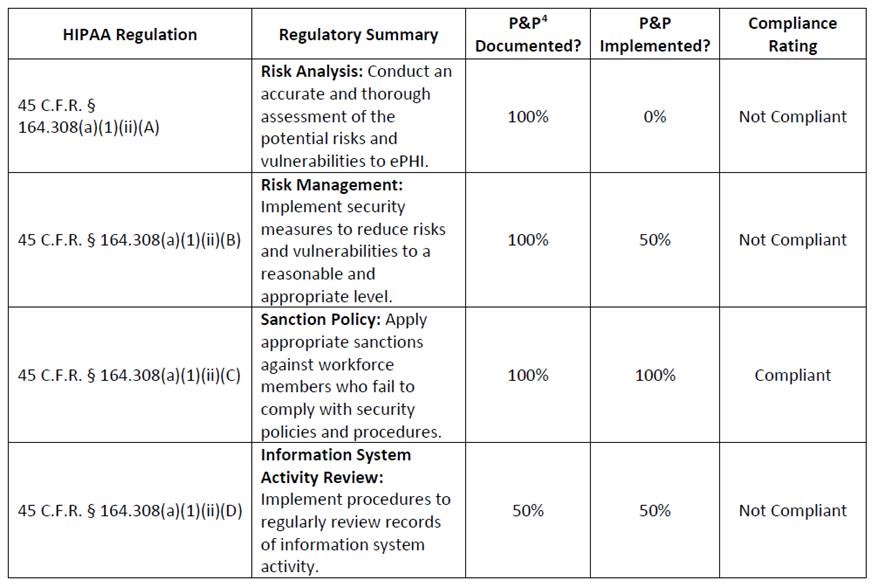
 

An entity’s gap analysis generally does not satisfy the risk analysis obligations because it typically does not demonstrate an accurate and thorough assessment of the risks to all of the ePHI an entity creates, receives, maintains, or transmits (See 45 C.F.R. §164.308(a)(1)(ii)(A)).

Resources for conducting a risk analysis are available on OCR’s web site at https://www.hhs.gov/hipaa/for-professionals/security/guidance/guidance-risk-analysis/index.html).
OCR’s HIPAA audit protocol may be helpful to those entities seeking information on their compliance with the HIPAA Rules (See https://www.hhs.gov/hipaa/for-professionals/compliance-enforcement/audit/protocol/index.html).

Tags: Risk Assessment
No Comments
Share
0

You also might be interested in

Introducing HIPAA Secure Now!

Feb 13, 2011

We are proud to announce the launch of the HIPAA[...]

Why perform a Risk Assessment?

Feb 15, 2011

A Risk Assessment is required in order to comply with[...]

Using patient record security as a competitive advantage

Using patient record security as a competitive advantage

Mar 7, 2011

The following blog was written a year ago but the[...]

Leave a Reply Cancel Reply

Recent Posts

  • What Is Acceptable Use in a Medical Office?
  • Most Healthcare Leaders See the Promise of GenAI—Only 36% Feel Ready
  • How to Use Microsoft 365 Securely in a Shared Office Environment
  • Why Your HIPAA Policies Shouldn’t Live in a Drawer
  • Is Your Staff Prompting AI Safely? What You Need to Know Now

Recent Comments

  • Why Your Practice Needs an AI Acceptable Use Policy - HIPAA Secure Now! on How Gen AI is Transforming Everyday Healthcare
  • HIPAA Security Rule Changes 2025: What Your Healthcare Practice Must Know Now - The HJN Blog on 2025 HIPAA Security Rule Updates
  • Too Small for an OCR Audit? 2025 Proves Otherwise - HIPAA Secure Now! on How Engaging Training Reduces Employee Errors in Healthcare
  • 2025 HIPAA Security Rule Updates - HIPAA Secure Now! on How Engaging Training Reduces Employee Errors in Healthcare
  • Overcoming HIPAA Compliance Challenges for Small Healthcare Practices - HIPAA Secure Now! on How Engaging Training Reduces Employee Errors in Healthcare

Archives

  • July 2025
  • June 2025
  • May 2025
  • April 2025
  • March 2025
  • February 2025
  • January 2025
  • December 2024
  • November 2024
  • October 2024
  • September 2024
  • August 2024
  • July 2024
  • June 2024
  • May 2024
  • April 2024
  • March 2024
  • February 2024
  • January 2024
  • December 2023
  • November 2023
  • October 2023
  • September 2023
  • August 2023
  • July 2023
  • June 2023
  • May 2023
  • April 2023
  • March 2023
  • February 2023
  • January 2023
  • December 2022
  • November 2022
  • October 2022
  • September 2022
  • August 2022
  • July 2022
  • June 2022
  • May 2022
  • April 2022
  • March 2022
  • February 2022
  • January 2022
  • December 2021
  • November 2021
  • October 2021
  • September 2021
  • August 2021
  • July 2021
  • June 2021
  • May 2021
  • April 2021
  • March 2021
  • February 2021
  • January 2021
  • December 2020
  • November 2020
  • October 2020
  • September 2020
  • August 2020
  • July 2020
  • June 2020
  • May 2020
  • April 2020
  • March 2020
  • February 2020
  • January 2020
  • December 2019
  • November 2019
  • October 2019
  • September 2019
  • August 2019
  • July 2019
  • June 2019
  • May 2019
  • April 2019
  • March 2019
  • February 2019
  • January 2019
  • November 2018
  • October 2018
  • September 2018
  • August 2018
  • July 2018
  • June 2018
  • May 2018
  • April 2018
  • March 2018
  • February 2018
  • January 2018
  • December 2017
  • November 2017
  • October 2017
  • September 2017
  • August 2017
  • July 2017
  • June 2017
  • May 2017
  • April 2017
  • March 2017
  • February 2017
  • January 2017
  • December 2016
  • November 2016
  • October 2016
  • September 2016
  • August 2016
  • July 2016
  • June 2016
  • May 2016
  • April 2016
  • March 2016
  • February 2016
  • January 2016
  • December 2015
  • November 2015
  • October 2015
  • September 2015
  • August 2015
  • June 2015
  • May 2015
  • April 2015
  • March 2015
  • February 2015
  • January 2015
  • December 2014
  • November 2014
  • October 2014
  • September 2014
  • August 2014
  • July 2014
  • June 2014
  • May 2014
  • April 2014
  • March 2014
  • February 2014
  • January 2014
  • December 2013
  • November 2013
  • October 2013
  • September 2013
  • August 2013
  • July 2013
  • June 2013
  • May 2013
  • April 2013
  • March 2013
  • February 2013
  • January 2013
  • December 2012
  • November 2012
  • October 2012
  • September 2012
  • July 2012
  • June 2012
  • May 2012
  • April 2012
  • March 2012
  • February 2012
  • January 2012
  • December 2011
  • November 2011
  • October 2011
  • September 2011
  • August 2011
  • July 2011
  • June 2011
  • May 2011
  • April 2011
  • March 2011
  • February 2011

Categories

  • Backup & Disaster Recovery
  • Business Associates
  • Client News
  • Download
  • Healthcare Industry
  • HIPAA
  • HIPAA Audits
  • HIPAA Violations
  • HSN News
  • Legal
  • MACRA
  • Policies and Procedures
  • Press Release
  • Remote Workforce
  • Risk Assessment
  • Scams
  • Security
  • Security Reminders
  • Security Training
  • Telehealth
  • Uncategorized
  • Webinar
  • Website

Meta

  • Log in
  • Entries feed
  • Comments feed
  • WordPress.org

Contact Us

  • HIPAA Secure Now
  • 55 Madison Ave, Suite 400 Morristown, NJ 07960
  • (877) 275 - 4545
  • info@hipaasecurenow.com

Find us on Social Media

LEGAL

Privacy Policy

Terms of Service

Subscribe to our Newsletter

  • Hidden

© 2025 · HIPAA Secure Now!

Prev Next