• Blog
  • Services
    • PHIshMD Ongoing Training
    • HIPAA Compliance
    • Discover Vulnerabilities to Patient PHI
  • Store
    • HIPAA Secure Now Service Store
  • Contact Us
    • Sales Inquiry
    • Customer Support
  • Resources
    • Free Healthcare Security Check Up Quiz
    • HIPAA Compliance Requirements | A Guide
    • Webinars & Downloadable Content
    • Use our free Breach Cost Calculator
    • HIPAA Secured Seal
    • In-Email Training & Analysis | Catch Phish

Call us at: 877-275-4545

Client or Partner? Login here
HIPAA Secure Now!HIPAA Secure Now!
  • Blog
  • Services
    • PHIshMD Ongoing Training
    • HIPAA Compliance
    • Discover Vulnerabilities to Patient PHI
  • Store
    • HIPAA Secure Now Service Store
  • Contact Us
    • Sales Inquiry
    • Customer Support
  • Resources
    • Free Healthcare Security Check Up Quiz
    • HIPAA Compliance Requirements | A Guide
    • Webinars & Downloadable Content
    • Use our free Breach Cost Calculator
    • HIPAA Secured Seal
    • In-Email Training & Analysis | Catch Phish

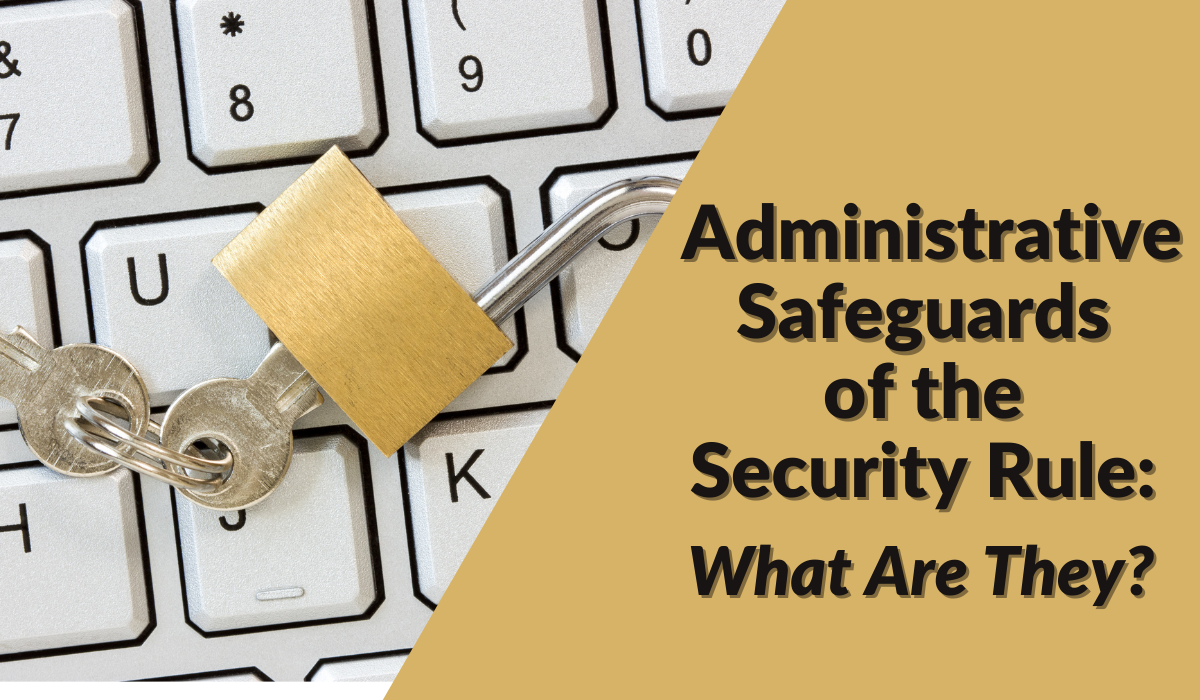
Administrative Safeguards of the Security Rule: What Are They?

November 15, 2021 Posted by Art Gross HIPAA, Policies and Procedures No Comments

The HIPAA Security Rule requires healthcare providers and their business associates to implement physical, technical, and administrative safeguards to protect the electronic Protected Health Information (PHI) that they utilize. It establishes national standards to protect that information. These standards apply not just to covered entities, but any organization that handles PHI – including subcontractors and business associates. 

 Administrative safeguards (also called “administrative security”) are procedures, or policies, that ensure compliance with HIPAA’s administrative simplification rules. They compromise over half of the requirements of the HIPAA Security Rule and refer to organizational security measures. These security measures are extensions of the security management process within a business.  

 These standards are for all covered entities, including small businesses with few resources and large medical facilities that use numerous outside service providers. Administrative safeguards differ from the security practices required by the security rule; they provide a security framework that all personnel can easily understand and use to meet security goals. 

Administrative safeguards are broken down into two classifications: addressable or required.  

 Security Management Process – Required standards that implement policies and procedures to prevent, detect, contain, and correct security violations.  

 Assigned Security Responsibility – This required standard that a business must identify who will be responsible for ensuring that the covered entity will comply with the Security Rule. One person can be both the Security and Privacy Officers.  

 Workforce Security – Addressable standards which identify if all members of a workforce have appropriate access to ePHI and prevent those who shouldn’t have access from acquiring it. 

 Information Access Management – A required standard that ensures that PHI is only accessible by the parties which require access in the case of a health care clearinghouse. Addressable aspects are access authorization, establishment, and modification.  

 Security Awareness and Training – Addressable standards but very important.  If a covered entity doesn’t train its workforce, the safeguards are useless. This includes security reminders, protection from malicious software, log-in monitoring, and password management.  

 Security Incident Procedures – A required standard that identifies how a workforce should respond in the case of a security incident.  

 Contingency Plan – A combination of both required and addressable standards which outline how the covered entity will recover access because of a security incident.  This includes data backup, disaster recovery, and emergency mode plans that are required. Testing and revision procedures along with applications and data criticality analysis are addressable.  

 Evaluation – It is required to implement ongoing monitoring and evaluation plans.  

 Business Associate Contracts and Other Arrangements are required to meet the application organizational requirements.  This agreement confirms that both parties will be HIPAA compliant in their usage of any PHI.  

 The security rule requires covered entities to update their security management process every year and to review it at least once every three years. It is particularly important for small health care providers or organizations that lack dedicated IT departments to establish effective administrative safeguards.  If you aren’t sure about these Administration Standards or any other part of your business’s HIPAA or cybersecurity plan, HIPAA Secure Now can help! 


Tags: Administrative SafeguardsHIPAA Security Rule
No Comments
Share
1

You also might be interested in

HIPAA Security Policies

HIPAA Security Policies

Mar 21, 2023

. In healthcare, it is crucial to ensure the security[...]

Non-Cloud Backups: A Lifeline for Healthcare

Non-Cloud Backups: A Lifeline for Healthcare

Aug 28, 2023

IT Experts Fall Victim to Cyberattack Last week, CloudNordic, a[...]

A Dynamic Duo: Cybersecurity and Compliance

A Dynamic Duo: Cybersecurity and Compliance

Oct 2, 2023

Introduction In a world where health records are considered 50[...]

Leave a Reply Cancel Reply

Recent Posts

  • What Is Acceptable Use in a Medical Office?
  • Most Healthcare Leaders See the Promise of GenAI—Only 36% Feel Ready
  • How to Use Microsoft 365 Securely in a Shared Office Environment
  • Why Your HIPAA Policies Shouldn’t Live in a Drawer
  • Is Your Staff Prompting AI Safely? What You Need to Know Now

Recent Comments

  • Why Your Practice Needs an AI Acceptable Use Policy - HIPAA Secure Now! on How Gen AI is Transforming Everyday Healthcare
  • HIPAA Security Rule Changes 2025: What Your Healthcare Practice Must Know Now - The HJN Blog on 2025 HIPAA Security Rule Updates
  • Too Small for an OCR Audit? 2025 Proves Otherwise - HIPAA Secure Now! on How Engaging Training Reduces Employee Errors in Healthcare
  • 2025 HIPAA Security Rule Updates - HIPAA Secure Now! on How Engaging Training Reduces Employee Errors in Healthcare
  • Overcoming HIPAA Compliance Challenges for Small Healthcare Practices - HIPAA Secure Now! on How Engaging Training Reduces Employee Errors in Healthcare

Archives

  • July 2025
  • June 2025
  • May 2025
  • April 2025
  • March 2025
  • February 2025
  • January 2025
  • December 2024
  • November 2024
  • October 2024
  • September 2024
  • August 2024
  • July 2024
  • June 2024
  • May 2024
  • April 2024
  • March 2024
  • February 2024
  • January 2024
  • December 2023
  • November 2023
  • October 2023
  • September 2023
  • August 2023
  • July 2023
  • June 2023
  • May 2023
  • April 2023
  • March 2023
  • February 2023
  • January 2023
  • December 2022
  • November 2022
  • October 2022
  • September 2022
  • August 2022
  • July 2022
  • June 2022
  • May 2022
  • April 2022
  • March 2022
  • February 2022
  • January 2022
  • December 2021
  • November 2021
  • October 2021
  • September 2021
  • August 2021
  • July 2021
  • June 2021
  • May 2021
  • April 2021
  • March 2021
  • February 2021
  • January 2021
  • December 2020
  • November 2020
  • October 2020
  • September 2020
  • August 2020
  • July 2020
  • June 2020
  • May 2020
  • April 2020
  • March 2020
  • February 2020
  • January 2020
  • December 2019
  • November 2019
  • October 2019
  • September 2019
  • August 2019
  • July 2019
  • June 2019
  • May 2019
  • April 2019
  • March 2019
  • February 2019
  • January 2019
  • November 2018
  • October 2018
  • September 2018
  • August 2018
  • July 2018
  • June 2018
  • May 2018
  • April 2018
  • March 2018
  • February 2018
  • January 2018
  • December 2017
  • November 2017
  • October 2017
  • September 2017
  • August 2017
  • July 2017
  • June 2017
  • May 2017
  • April 2017
  • March 2017
  • February 2017
  • January 2017
  • December 2016
  • November 2016
  • October 2016
  • September 2016
  • August 2016
  • July 2016
  • June 2016
  • May 2016
  • April 2016
  • March 2016
  • February 2016
  • January 2016
  • December 2015
  • November 2015
  • October 2015
  • September 2015
  • August 2015
  • June 2015
  • May 2015
  • April 2015
  • March 2015
  • February 2015
  • January 2015
  • December 2014
  • November 2014
  • October 2014
  • September 2014
  • August 2014
  • July 2014
  • June 2014
  • May 2014
  • April 2014
  • March 2014
  • February 2014
  • January 2014
  • December 2013
  • November 2013
  • October 2013
  • September 2013
  • August 2013
  • July 2013
  • June 2013
  • May 2013
  • April 2013
  • March 2013
  • February 2013
  • January 2013
  • December 2012
  • November 2012
  • October 2012
  • September 2012
  • July 2012
  • June 2012
  • May 2012
  • April 2012
  • March 2012
  • February 2012
  • January 2012
  • December 2011
  • November 2011
  • October 2011
  • September 2011
  • August 2011
  • July 2011
  • June 2011
  • May 2011
  • April 2011
  • March 2011
  • February 2011

Categories

  • Backup & Disaster Recovery
  • Business Associates
  • Client News
  • Download
  • Healthcare Industry
  • HIPAA
  • HIPAA Audits
  • HIPAA Violations
  • HSN News
  • Legal
  • MACRA
  • Policies and Procedures
  • Press Release
  • Remote Workforce
  • Risk Assessment
  • Scams
  • Security
  • Security Reminders
  • Security Training
  • Telehealth
  • Uncategorized
  • Webinar
  • Website

Meta

  • Log in
  • Entries feed
  • Comments feed
  • WordPress.org

Contact Us

  • HIPAA Secure Now
  • 55 Madison Ave, Suite 400 Morristown, NJ 07960
  • (877) 275 - 4545
  • info@hipaasecurenow.com

Find us on Social Media

LEGAL

Privacy Policy

Terms of Service

Subscribe to our Newsletter

  • Hidden

© 2026 · HIPAA Secure Now!

Prev Next